
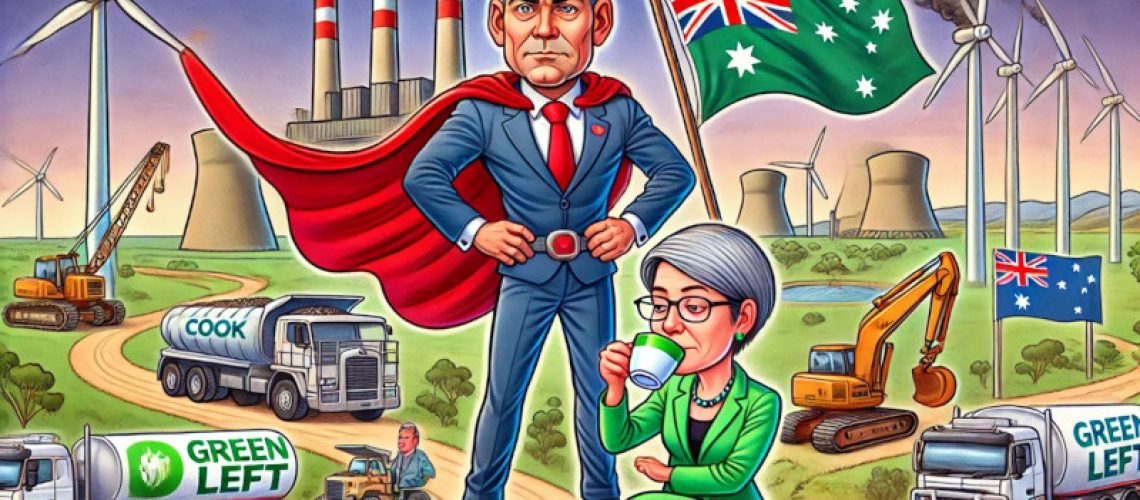
Western Australia’s Premier Roger Cook is becoming one of the more intriguing figures in Australian politics. His latest intervention—opposing the Federal Government’s “Nature Positive” environmental laws—must be leaving the Green Left spluttering into their organic green tea.
Environment Minister Tanya Plibersek’s Nature Positive Bill, as initially proposed, was poised to deliver crippling delays to project approvals while entangling industries in layers of green tape. The legislation seemed almost nostalgic for a pre-mining, pre-industrial era when Australia relied solely on “the sheep’s back” for its wealth. While this might appeal to the remnants of the stockacracy—(unfortunately WA has few of them left), it would send WA back to being an improvised backwater relying on grants from the other states to survive.
The Nature Positive Bill, with its ambiguous “climate trigger,” threatens to paralyse Australia’s mining and energy sectors, the very engines of our national economy. To grasp the consequences, consider Australia’s GDP per capita without its gas, coal, and iron ore exports. Based on rough calculations, we’d end up poorer than New Zealand (GDP per Capita $73,506 vs Australia’s $104,456). Take it further: add the economic constraints of the 2030 and 2050 net-zero targets, and we’re hurtling toward Greece’s GDP per capita levels ($45,000, including their crippling debt). To show you what that means when it comes to living standards Greece’s average workers income is a mere $35,634 AUD—compared to New Zealand $47,892 and Australia’s $100,017 AUD.
Premier Cook appears to have joined the dots and realised the urgency of insulating WA from the economic illiteracy coming from Canberra. His submission to the Senate inquiry into the Nature Positive Bill made for fascinating reading, laying out the dire implications for WA should environmental approvals be tied to the unrealistic goal of “zero impact” project development.
Of course, no one in Canberra seemed to pay attention. Plibersek and her department, likely viewing the bill through their green tinted glasses saw the new laws as yet another tool to shutter extractive industries in pursuit of a utopian green nirvana.
But Cook’s principled stance—including warnings against climate trigger mechanisms and, reportedly, a blunt conversation with Albanese—no doubt hinting which of them would be going under the bus proved pivotal. It’s likely Cook reminded the Prime Minister of the electoral risks this legislation posed in WA ahead of the next state election. His intervention appears to have derailed a deal between Labor and the Greens, sparing WA from regulations that could have spelled economic disaster.
This isn’t the first time Premier Cook has stepped in to protect WA from poorly conceived policies. Last year, he reined in the contentious State Aboriginal Heritage Act, taking control of a runaway department and an activist minister. He also intervened to halt the State Water Bill, which flirted with granting Aboriginal veto power over water projects. Notably, Cook has also resisted the push for a state treaty or voice, avoiding the costly paths followed by South Australia, Victoria, and Queensland—moves that would have undoubtedly thrilled his cabinet’s progressive wing.
Cook’s ability to push back against the Left within his own faction is refreshing. It demonstrates a rare quality among modern Labor leaders: the recognition that wealth is not created by borrowing money, locking up resources, or indulging in endless virtue-signaling. Choosing industry over activists is never easy for a leader on the Left, but Cook has shown he is willing to make the hard calls. If only his federal colleagues shared his pragmatic approach.
Beyond safeguarding industry, Cook has continued his predecessor Mark McGowan’s commitment to fiscal restraint. WA remains the standout in terms of budget management—something no other state has achieved, and the previous Liberal-National government struggled to emulate. This fiscal discipline sets Cook apart as a leader who prioritises long-term economic stability over short-term political gain.
The farming community, often sceptical of Labor governments, must acknowledge that Cook has set a high bar for the Liberals and Nationals to meet in the upcoming election. While rural WA may not always receive its fair share of the state’s wealth, and while some of Cook’s ministers may be less than competent, there’s no denying that WA has fared far better under McGowan and Cook than other states have under their own leaders.
To Premier Cook: your efforts to protect WA’s industries, manage the budget responsibly, and stand firm against excessive regulation have not gone unnoticed. You’ve set a benchmark for pragmatic leadership that all WA political parties would do well to emulate as they prepare for the next state election.
In turn the states Liberals and Nationals need to face up that they need to take an aggressive high risk approach to the policies they take to the next election. They need to go far beyond simply spending the surplus or telling Canberra to “bugger off,” those spaces now belong to Cook.

