
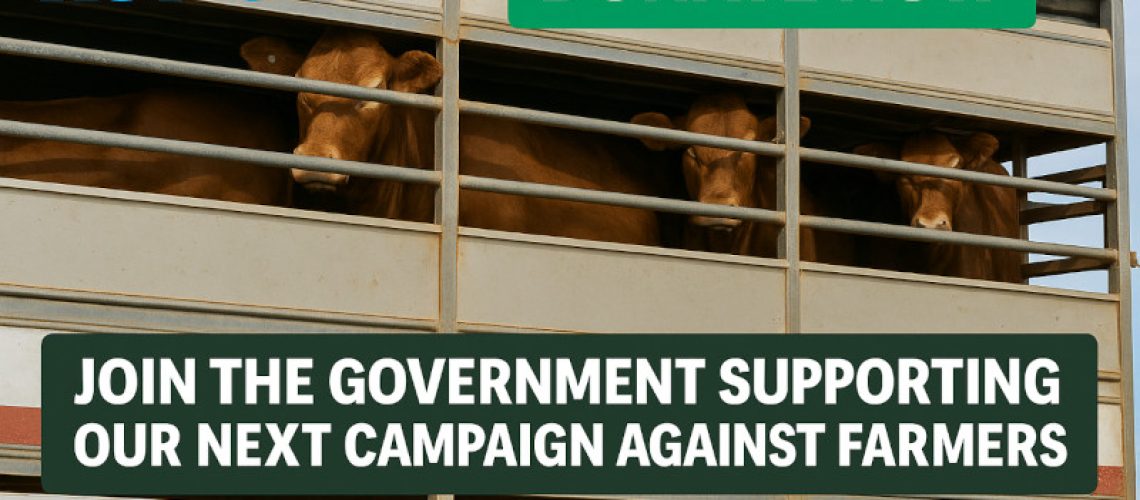
So it begins.
This week, the Federal Minister for Agriculture has finally — after 14 months of paralaysis — confirmed that the rollout of the transition package for phasing out live sheep exports will begin sometime in the next 12 months!
To add insult to injury, there’s still no detail on how farmers will be assessed when applying for funding. But don’t worry — we’re told the best and brightest are working on it. In fact, $20 million of the $139 million package has already been set aside just to administer the process.
But I don’t want to focus on that today.
What I want to delve into is this: where are our friends from the RSPCA — or as they’re more accurately known in the bush, the Organisation Routinely Soliciting Public Cash for Activism?
After all, this is the same outfit that spent four years relentlessly campaigning to shut down the live sheep trade, with its WA President repeatedly assuring us they’d “support the transition”… just as soon as we agreed to walk away from the industry.
Well, now they’ve got what they wanted. Time to make good on the promise.
They could start by putting that $7 million taxpayer handout they secured from the WA Government — just before the last state election — to work supporting farmers. At the time, they insisted it would go toward education and enforcement, not activism. But given the timing — and their long-standing role as the loudest voice in the “ban the boats” campaign — one has to ask: is that money really going toward caring for cats and dogs? Or will it bankroll the next round of anti-farming campaigns?
Because make no mistake — the next round is already being drafted. With the live sheep trade legislated into oblivion, the long-distance transport of livestock is firmly in the crosshairs. So too is the live x cattle trade. The activist playbook doesn’t end with sheep.
Back in April, RSPCA WA President Lynne Bradshaw took to the rural press to “set the record straight” in defence of that $7 million. In doing so, she inadvertently confirmed what WAFarmers and the broader livestock industry have been warning about for years: the RSPCA has morphed into a confused and dangerous hybrid — part public authority, part political campaigner, part charity — but with no clear accountability.
Bradshaw insisted the RSPCA is “not anti-farming”, “not a lobby group”, and not misusing public funds. But strip away the spin, and what’s left is an organisation that wants the legal powers of a government agency, the freedom of a political campaigner, and the public funding of both — all without any of the checks, balances, or democratic oversight that come with it.
Let’s be absolutely clear: the RSPCA WA is not a government agency. It’s a private charity, incorporated under associations law, with a board unelected by the public and accountable only to itself and its donors. Yet it receives delegated enforcement powers under the Animal Welfare Act while simultaneously lobbying to reshape the very industries it polices. That’s not just a conflict of interest — it’s a democratic farce.
Bradshaw herself confirmed that the RSPCA does spend on lobbying — claiming it’s “only 0.5%” of its $10 million budget. But this isn’t about dollar amounts. It’s about the fact that every public dollar they receive cross-subsidises political activity, and the fact that the “Royal” in their title gives them outsized political influence. When the RSPCA lobbies, politicians listen — and farmers pay.
Their claims of “advocating for farmers” ring especially hollow in light of their conduct during the live export debate. Bradshaw was on record for calling for a “fair transition.” But where were the signs reading “Phase it out, support the producers”? What we got was “Ban Live Export” — loud, absolute, and unwavering. And now that the ban is locked in and the pathetically inadequate funding has begun to flow sometime in the next 12 months, we’re expected to believe the RSPCA always just wanted to help farmers.
The truth is, the RSPCA never had a plan to help farmers transition. It never had the intention, or the resources, to put any real money on the table. It needs every cent from its branded food labels and government grants to fund its next anti-agriculture campaign.
Let’s face it: if the RSPCA couldn’t demonise farmers, its fundraising model would collapse. That reality says more about their mission creep than about the state of animal welfare on Australian farms.
And if they were truly interested in supporting livestock producers, they’d drop their long-held policy position that all farm animals should be slaughtered as close as possible to the point of production. It sounds harmless, but it’s a Trojan horse — a policy that, if implemented, would effectively outlaw the trucking or shipping of livestock to all but the nearest abattoir. And once again, it would be farmers — not activists — left carrying the cost.
So I will put a challenge to the RSPCA. Drop the activism and policy on distance to processing and back the long haul trucking of livestock and the shipping of cattle, or give the taxpayers dollars back to government.
The RSPCA cant have it both ways
They want power without accountability, public money without scrutiny, and political influence without responsibility. Until they choose whether they’re a care giver, a regulator or a lobbyist, they have no business using tax payers money to do all three. The future of Australian livestock farming depends on drawing that line.

