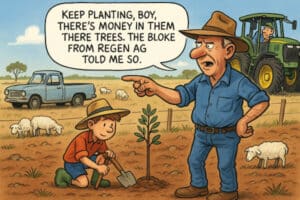

Another week, another glossy press release announcing that regenerative agriculture has once again rediscovered the secret to farming profitability. This time it arrives wrapped in the language of “Natural Capital Accounting,” pushed proudly by Perth NRM, RegenWA and their national partners, and backed by a study now published in the Agricultural Systems journal.
According to the headline findings, mixed farms in WA with “more trees integrated into the landscape” earned an extra $100 per hectare in livestock gross margin and $200 per hectare in whole-farm profit.
If we take that at face value, the average 3,000-hectare broadacre farm in WA is missing out on somewhere between $300,000 and $600,000 a year simply because it hasn’t planted enough trees. If that were true, every agronomist, consultant and banker in the state should immediately be marched to the front gate and told not to come back. It would mean the regen movement, armed with a clipboard, a drone and some good vibes, has done what the entire agricultural advisory industry failed to do for decades: uncover the biggest profit driver in WA farming since the introduction of superphosphate.
But as with every regen announcement, the closer you look, the stranger it gets.
We still have the same unresolved problem the movement has battled for years: nobody can define Regenerative Agriculture in a way that is consistent, testable or operational. Ask five regen advocates what it means and you’ll get five different answers, all of them warm, virtuous and utterly useless for running a business.
“Working with nature.”
“Building healthy landscapes.”
“Enhancing natural capital.”
Wonderful sentiments, but no actual recipe. If regen were a chemical product, the ACCC would have hauled it off the shelf for selling an unlabelled bottle of mystery liquid.
Then there’s the study itself.
We’re told it is Australia’s most comprehensive analysis to date, and perhaps it is—though in WA, the dataset is just sixteen farms.
Sixteen.
Hand-selected through existing networks, ecological surveys and self-nominating producers. It is not a random sample. It is not a cross-section of soil zones. It certainly isn’t a statistically robust representation of WA agriculture. Yet out of this extremely narrow pool, the researchers feel confident enough to proclaim statewide economic truths.
What’s more remarkable is what they did not do. WA already has the largest independent farm business dataset in the country: Planfarm Benchmarking. If the alleged link between natural capital and profit is as strong as advertised, the simplest test in the world would be to run the numbers through Planfarm and see whether the pattern holds across 500–700 commercial operations.
But that would risk shattering the narrative, because every ag economist in WA knows the outcome: once you adjust for rainfall, soil type, enterprise mix and arable hectares, the correlation would collapse. Geography explains far more of WA’s profitability than tree density ever has. Yet in the public messaging, nuance is gently swept aside and replaced with sweeping claims that trees increase profit.
It’s a seductive idea—low cost, low effort, full of moral glow—but the economics don’t stack up.
A 1,000-acre paddock with more trees is not suddenly more productive. Trees reduce arable area, harbour pests, complicate machinery operations, shade out crop zones, and provide habitat for every kangaroo in the postcode. The notion that the quickest route to higher profit is to give up farming land is the kind of economics only a grant-funded consultant could love.
The real top-performing farms in WA—the true top 20 percent—do not get there by intuition, vibes or leaf-counting. They get there by doing the hard, sometimes tedious, mostly unromantic work of farming: optimising inputs, managing risk, rotating wisely, applying the right chemistry, running numbers, investing in scale and being ruthless on cost. There is nothing mystical about it. It’s business discipline and agronomic precision, not planting trees and hoping biodiversity fairies boost your EBIT.
But correlation is the regen movement’s favourite business model.
Trees correlate with better land, better rainfall and better microclimates—of course the farms with more remnant vegetation also perform well. They always have. So do the ones with no trees on them at all, in fact I bet many of them are our top performing farms. Trees are not the cause of the profit. It makes them an indicator of natural advantage and are nice to look at. A bit of shade is good animal welfare but you don’t need trees to provide shade when shade cloth can do the same thing.
Economics 101: correlation does not equal causation.
Yet regen advocates seem determined to build an entire industry on getting those two concepts confused.
Worse, much of this work has now expanded into carbon markets, “natural capital” scorecards, and schemes to financially reward farmers for landscape features that have never been proven to improve productivity once you strip away environmental romanticism. In many ways, the regen movement behaves like the wellness or the healthfood industry: big assertions, small datasets, confident marketing, and a steadfast refusal to test their claims against independent scrutiny.
If Perth NRM, RegenWA and the wider regen apparatus truly believe their findings, the next step is not another media release. It is to run the whole dataset—every farm, every figure—through Planfarm Benchmarking. Publish the comparison. Open it to scrutiny. Do what science and economics require: replicate, separate variables, eliminate confounders, and match like-for-like.
If the results stand, WA farmers will change practices tomorrow and I will become their loudest supporter. If they don’t—and I suspect they won’t—then this entire natural-capital profitability narrative will unravel exactly as previous regen claims have: with a quiet retreat and a new buzzword replacing the old.
Because that is the uncomfortable truth: regen keeps promising miracles but never delivers evidence that survives independent analysis. And until it does, the movement remains less a farming system and more a belief system—pleasant, well-intentioned, feel-good, but economically hollow.
The time has come to put it to the test. Scientific test. Economic test. Farm-business test.
Until then, WA agriculture is being sold a story—one that feels nice, looks green, photographs beautifully, but just doesn’t add up.